
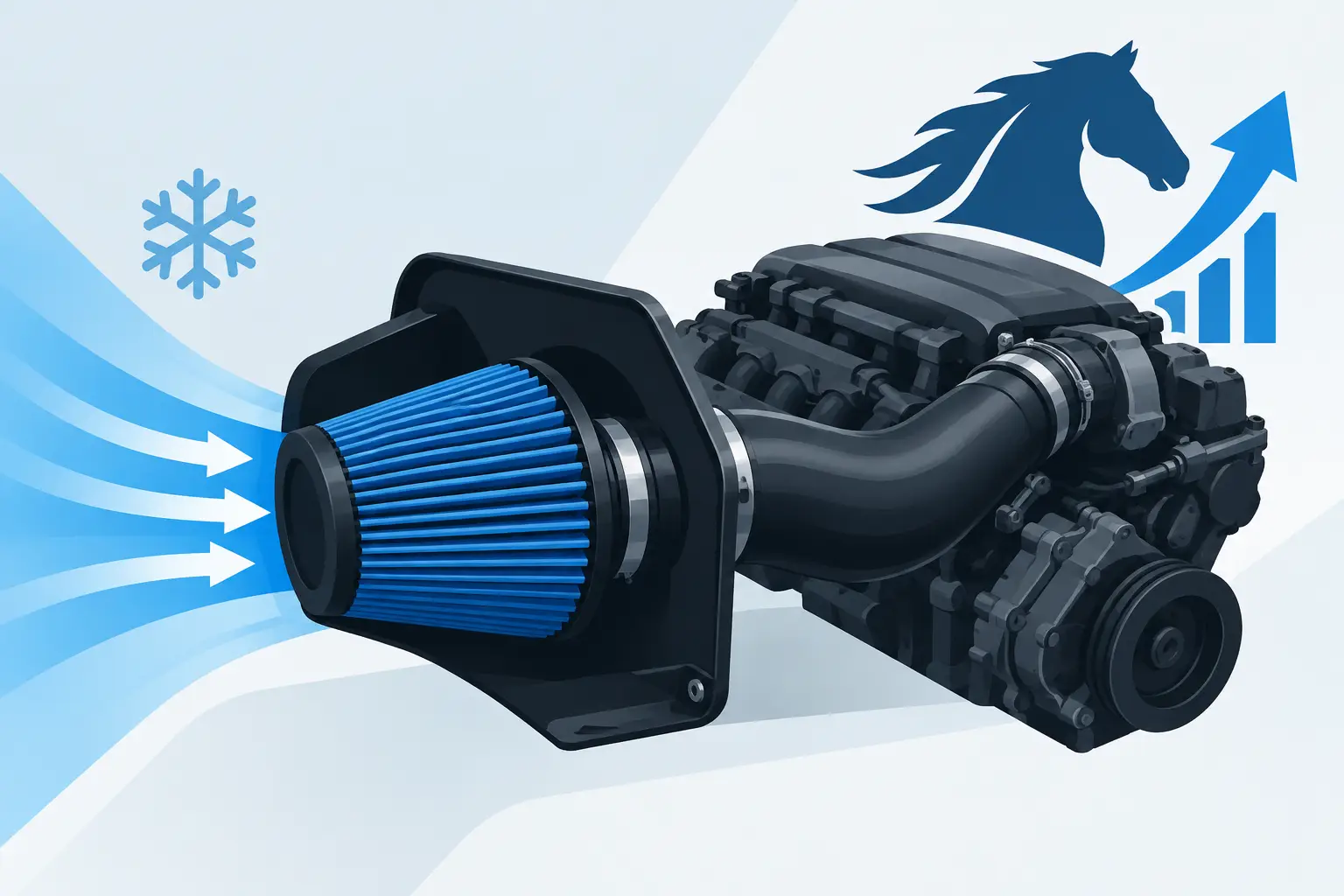
A factory airbox is designed to balance cost, noise control, filtration, packaging, and performance. That balance can leave power on the table when an engine needs more airflow at higher rpm. Real cold air intake horsepower gains come from reducing intake restriction and supplying the engine with cooler, denser air – but the result is never a single number that applies to every vehicle.
For a daily driver, the first difference may be sharper throttle response and a more purposeful intake sound. For a turbocharged car, truck, or performance motorcycle, improved airflow can support stronger power gains when the rest of the engine setup can use it. The right expectations start with understanding what an intake system actually changes.
How a Cold Air Intake Can Add Power
An internal-combustion engine needs air, fuel, compression, and spark to make power. When the throttle opens, the engine draws air through the filter, intake tube, mass airflow sensor or manifold pressure sensor, throttle body, and intake manifold. Any unnecessary restriction in that path can limit the air available to the cylinders.
A cold air intake replaces selected factory intake components with a larger-flowing filter, smoother tubing, and a revised filter location or heat shield. The goal is to reduce pressure loss while keeping the incoming air as cool as practical. Cooler air is denser, so it contains more oxygen in a given volume. With the correct fuel delivery and ignition strategy, that oxygen allows the engine to produce more torque.
The filter matters as much as the tube. A high-flow, washable oiled cotton filter is engineered to capture contaminants while allowing the engine to breathe efficiently. That balance is critical. More airflow is useful only when the filtration media and intake design continue to protect the engine from damaging dirt and debris.
Why the Biggest Changes Happen at Higher Load
At idle and light cruising speeds, the engine uses relatively little air. A less restrictive intake may feel smoother, but it is unlikely to create a dramatic measurable increase in power. The intake becomes more relevant at wide-open throttle, higher rpm, towing load, or hard acceleration, when airflow demand rises quickly.
This is why dyno-tested gains are often measured near the upper part of the rev range. The engine is working hard enough for the factory intake restriction, air temperature, and intake geometry to make a meaningful difference. A system designed for a specific vehicle can improve the airflow path without creating turbulence that confuses factory sensors.
What Cold Air Intake Horsepower Gains Are Realistic?
For a naturally aspirated street vehicle, modest gains are the realistic expectation. Depending on the engine, factory intake design, ambient conditions, and calibration, an intake may add a few horsepower or potentially more where the original system is particularly restrictive. The improvement in throttle response and induction sound can feel larger than the peak horsepower figure.
Turbocharged and supercharged engines often have greater airflow potential, but the answer still depends on the complete setup. An intake can reduce restriction before the turbocharger, helping it draw air more easily. Yet the engine control unit, turbo size, intercooler efficiency, exhaust flow, fuel quality, and tune all influence the final result. An intake alone does not turn a stock vehicle into a fully modified build.
Published performance figures should always be read in context. Dyno results can vary with temperature, humidity, fuel, tire condition, transmission behavior, and the type of dynamometer used. A back-to-back test on the same vehicle, on the same day, is far more useful than comparing numbers from unrelated tests.
Horsepower Is Only Part of the Driving Experience
Peak horsepower is easy to market, but torque delivery is what many drivers notice first. If the engine reaches useful airflow more efficiently, it may feel more responsive when pulling away, passing, climbing, or accelerating onto a highway. A well-designed intake can also make the engine sound more immediate under throttle without affecting normal cruising manners.
For vehicle owners in hot, humid climates, intake air temperature deserves extra attention. Underhood heat can build quickly in slow traffic. An enclosed airbox, properly positioned heat shield, and fresh-air feed can help limit exposure to hot engine-bay air. A filter placed openly beside a hot exhaust manifold may look aggressive, but it is not automatically the best path to repeatable performance.
What Determines Your Actual Gain?
The vehicle itself is the largest variable. Some manufacturers fit roomy, efficient factory intake systems, leaving limited room for improvement. Others use restrictive inlet paths, narrow resonators, or compact paper filters that can become a bottleneck at high engine speeds.
Engine calibration is equally important. Modern vehicles continuously adjust airflow, fueling, and ignition based on sensor readings. A correctly engineered intake is designed to work with those controls. On some applications, the factory calibration can adapt to the improved airflow. On others, a tune may be necessary to extract the full potential of additional air-moving parts.
Consider these factors before setting a horsepower target:
- Engine type: Naturally aspirated, turbocharged, supercharged, gasoline, and diesel engines respond differently.
- Factory intake design: A restrictive stock system generally offers more opportunity than an already efficient one.
- Supporting modifications: Exhaust upgrades, intercooling, tuning, and throttle-body changes can alter the intake’s value.
- Operating conditions: Heat, humidity, elevation, and repeated stop-and-go use affect air density and consistency.
- Installation quality: Loose clamps, air leaks, misrouted sensors, and poorly sealed heat shields can reduce results or trigger warning lights.
The best approach is application-specific. Avoid universal intake parts unless they are intended for your exact engine and installation space. A vehicle-specific system accounts for sensor placement, hood clearance, mounting points, filter location, and the airflow characteristics the engine management system expects.
The Trade-Offs to Consider Before Installing
More intake sound is a benefit for many enthusiasts and a drawback for some commuters. Under acceleration, a high-flow intake often makes induction noise more noticeable. That sound is not proof of a large power increase, but it can make the vehicle feel more engaging.
Maintenance is another consideration. Washable, reusable filters can reduce the stream of disposable filters sent to landfill and can offer long-term value. They still require correct service intervals and the proper cleaning procedure. Over-cleaning, using unsuitable chemicals, or applying excessive filter oil can create avoidable issues. Follow the service guidance for your driving environment, especially if the vehicle operates on dusty roads, worksites, trails, or industrial areas.
Water exposure should also be taken seriously. A filter located lower in the engine bay may access cooler air, but it can be more vulnerable to deep standing water. Drivers who regularly encounter flooded roads should choose a system with sensible filter placement and use caution in severe weather. No intake modification changes the basic rule: do not drive through water that could reach the engine’s air inlet.
Choosing an Intake That Delivers More Than Noise
Look for a system built around your exact year, make, model, and engine. The strongest designs use properly sized tubing, secure brackets, heat management, durable couplers, and filter media that supports both airflow and contaminant control. Fitment is not a minor detail. It determines whether the system seals correctly, clears moving components, and maintains dependable sensor operation.
It is also worth separating a replacement air filter from a full cold air intake. A high-flow replacement filter fits inside the original airbox and can be an efficient first upgrade for drivers who want reusable filtration with minimal changes. A complete intake system replaces more of the airflow path and is generally the better choice when the goal is maximum airflow improvement, stronger induction character, and application-specific performance potential.
K&N intake systems and high-flow filters are built around this principle: improve the engine’s breathing without treating filtration or fitment as an afterthought. Select the correct application, install it carefully, and service the filter as recommended.
Install for Consistent Results
Before installation, inspect the factory intake path for cracked hoses, loose clamps, or existing fault codes. An intake upgrade cannot correct an unrelated ignition, fueling, boost, or sensor problem. Install with a cool engine, retain every required sensor and vent connection, and confirm that clamps are tight without being overtightened.
After installation, start the engine and listen for unusual hissing that may indicate an air leak. Check that the intake tube does not rub against sharp edges or hot components. Then drive normally long enough for the vehicle’s control system to adapt. If a warning light appears, recheck connector engagement, sensor orientation, and every joint in the intake tract before assuming the part is at fault.
A cold air intake is most rewarding when it matches the vehicle and the way you use it. Choose a properly engineered system, keep the filter maintained, and let measurable airflow improvements support the sharper response and stronger pull you expect from your engine.