
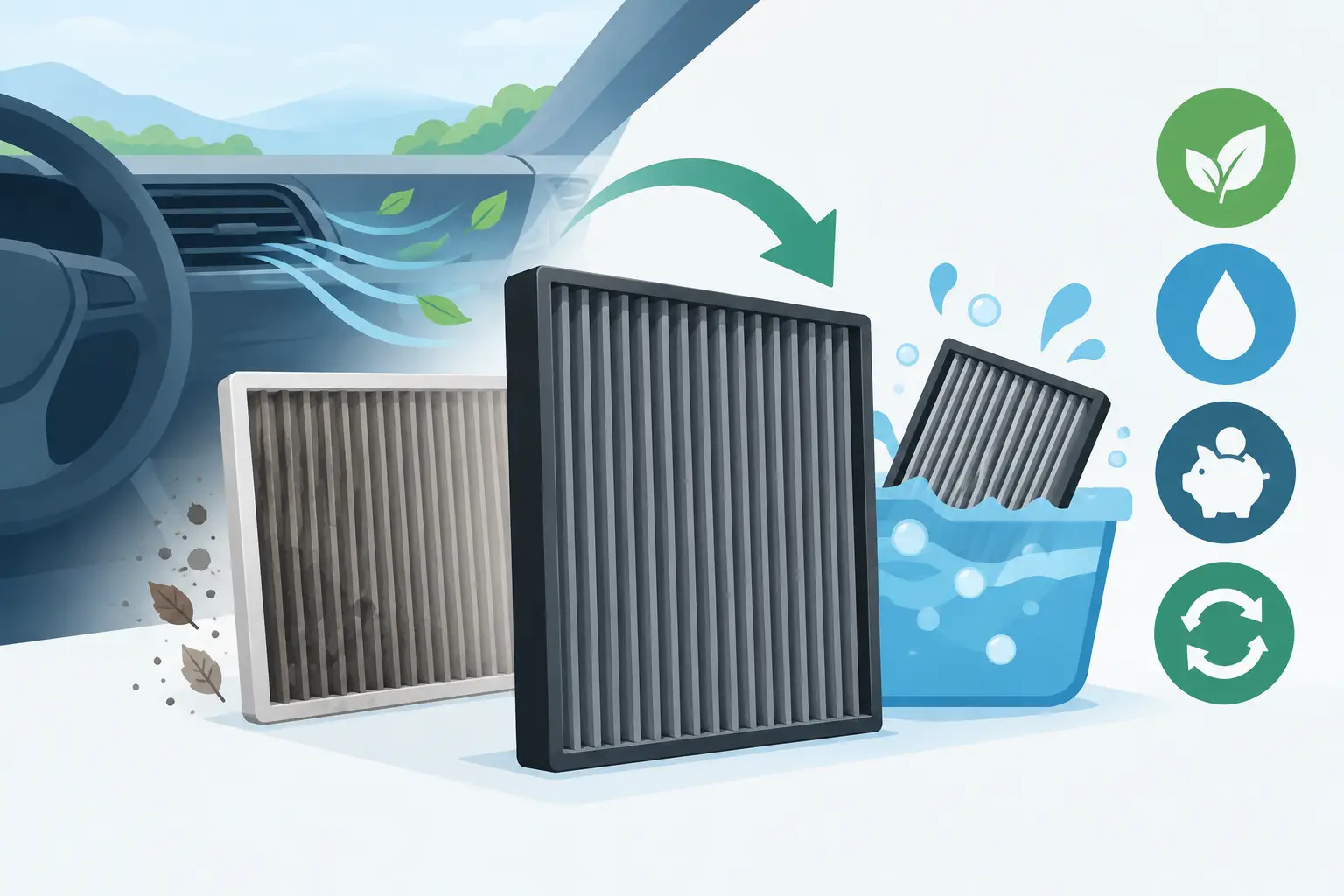
A washable reusable cabin air filter is a practical upgrade for drivers who are tired of treating every HVAC service as another disposable-parts purchase. It can help maintain cleaner airflow through the climate-control system while cutting the number of filters sent to the trash over the life of the vehicle. The value is real, but only when the filter fits correctly and is cleaned on schedule.
Unlike the engine air filter, which protects the engine from intake contaminants, the cabin air filter protects the air moving through the heating, ventilation, and air-conditioning system. It sits in the airflow path before air reaches the vents, helping capture dust, road debris, and other airborne particles that can accumulate around the blower and evaporator.
What a washable reusable cabin air filter does
Your cabin filter works every time the fan is running, whether you are using outside air or recirculation mode. Over time, a conventional disposable filter collects contaminants and can become restrictive. A loaded filter may contribute to weaker airflow from the vents, longer defogging times, and a musty smell when the air-conditioning system is switched on.
A washable reusable cabin air filter is built to be removed, cleaned, dried, and reinstalled rather than discarded at every service interval. The goal is straightforward: restore usable airflow and filtration performance without repeatedly buying and throwing away a replacement element.
For daily commuters, this means one less consumable item to track. For owners who keep vehicles for years, run multiple vehicles, or prefer to handle basic maintenance themselves, the savings and reduced waste can become meaningful. K&N has built its reputation around reusable filtration technology that gives vehicle owners a serviceable alternative to single-use filters.
Why cabin filter condition matters more than most drivers think
The cabin filter does not add horsepower or torque. Its job is different, but it still affects the ownership experience every time you drive. A clean filter supports the airflow your HVAC system needs to cool, heat, ventilate, and clear the windshield efficiently.
When airflow drops, drivers sometimes assume the blower motor or air-conditioning system has failed. In some cases, the simpler issue is a filter packed with dust, leaves, fine debris, and urban road grime. Replacing or cleaning the filter can be one of the fastest ways to address reduced vent output, provided there is no deeper mechanical fault.
There is also a protection angle. Debris that gets past a damaged, improperly fitted, or missing cabin filter can settle in HVAC components. Keeping the filter in serviceable condition helps reduce the buildup that contributes to unpleasant odors and unnecessary cleaning work later.
The reusable advantage: value, waste reduction, and serviceability
Disposable cabin filters are convenient because replacement is simple. Remove the old filter, install a new one, and move on. That convenience is useful for drivers who do not want to clean parts or wait for a filter to dry.
A reusable option trades some of that convenience for long-term serviceability. Instead of repeatedly purchasing filter media and a new frame, you maintain the same filter. If you are committed to routine vehicle care, that can lower replacement costs over time and keep fewer used filters out of landfills.
The economics depend on three things: the initial purchase price, how long you keep the vehicle, and how consistently you maintain the filter. A reusable filter is usually a stronger value proposition for a long-term owner than for someone planning to sell the vehicle in a few months. It also makes sense for enthusiasts who already clean their engine air filter, inspect fluids, and take care of their vehicles between workshop visits.
Choose the correct fitment before anything else
Cabin filter access and dimensions vary widely. Some filters slide out behind the glove compartment; others sit under the cowl, behind a trim panel, or in a more involved housing. Do not assume that two vehicles with similar engines use the same cabin filter.
Confirm the year, make, model, engine, and, where applicable, the trim level or chassis code. Pay attention to airflow direction markings. Installing a cabin filter upside down can compromise its fit and may affect how it handles debris. The filter should sit flat in its housing with no folded edges, open gaps, or forced cover panels.
A washable filter must be designed specifically for your cabin-filter housing. Do not attempt to wash and reuse a standard disposable paper filter. Once its media has been saturated, distorted, or weakened, it may no longer filter or seal as intended.
How to clean a reusable cabin filter properly
Service instructions vary by filter design, so the product-specific directions always take priority. Still, the basic process is consistent: remove the filter carefully, clear loose debris, wash it with an approved cleaner if required, rinse it gently, and allow it to dry completely before reinstalling it.
Avoid high-pressure water, aggressive brushes, compressed air at close range, or household chemicals not approved for the filter. These can damage filter media, separate bonded layers, or leave residues that you do not want circulating through the cabin.
Drying matters. Reinstalling a damp cabin filter can introduce unwanted moisture into the HVAC system and encourage odors. Plan the job when the vehicle can sit with the filter removed, or keep a temporary replacement on hand if you need to drive before the cleaned filter is fully dry.
After installation, run the fan at several speeds and check that the glove box, access panel, or cowl cover is properly secured. If airflow is still weak, inspect for blocked vents, blower issues, debris in the housing, or an HVAC fault beyond the filter itself.
When should you service it?
There is no single mileage number that suits every vehicle. Filter loading depends on where and how you drive. A car used mainly on clean highways may go longer between inspections than one used in dense traffic, near construction areas, on dusty roads, or in regions with frequent haze and heavy rainfall.
A good habit is to inspect the cabin filter during regular oil-service intervals or at least twice a year. Check it sooner if you notice a sudden drop in vent airflow, visible debris around the filter area, lingering odors, or a windshield that takes longer than usual to clear.
Recirculation mode can reduce the volume of outside contaminants entering the cabin, but it does not eliminate the need for filter service. Dust and debris can still collect, especially when the system is used often.
Understand the trade-offs before you buy
A washable reusable cabin air filter is not automatically the best option for every driver. If you want the quickest possible service with no cleaning or drying time, disposable filters remain the simpler route. If a vehicle is exposed to unusual contamination, such as heavy smoke, floodwater, chemical odors, or biological growth, replacement may be more appropriate than cleaning.
Drivers with severe allergies should also consider their specific needs. Not all cabin filters provide the same level of odor control or fine-particle filtration. Some disposable designs use activated carbon or specialized media aimed at particular airborne contaminants. Compare the filtration characteristics of the exact filter, not just whether it is reusable.
The best choice is the one that matches your driving environment, maintenance habits, and expectations for cabin-air quality. Reusability is valuable, but only when it does not compromise the filtration features you need.
Make cabin filter service part of smarter vehicle care
A clean, correctly fitted cabin filter is a small component with an everyday impact. It supports better HVAC airflow, helps keep debris out of the system, and can make routine maintenance less wasteful. For owners who prefer durable, serviceable parts, a washable reusable cabin air filter can be a smart long-term fit.
Before your next service, check the filter behind the glove box or in the HVAC housing. If it is dirty, damaged, or overdue for attention, addressing it now can make every drive feel cleaner, fresher, and better maintained.