
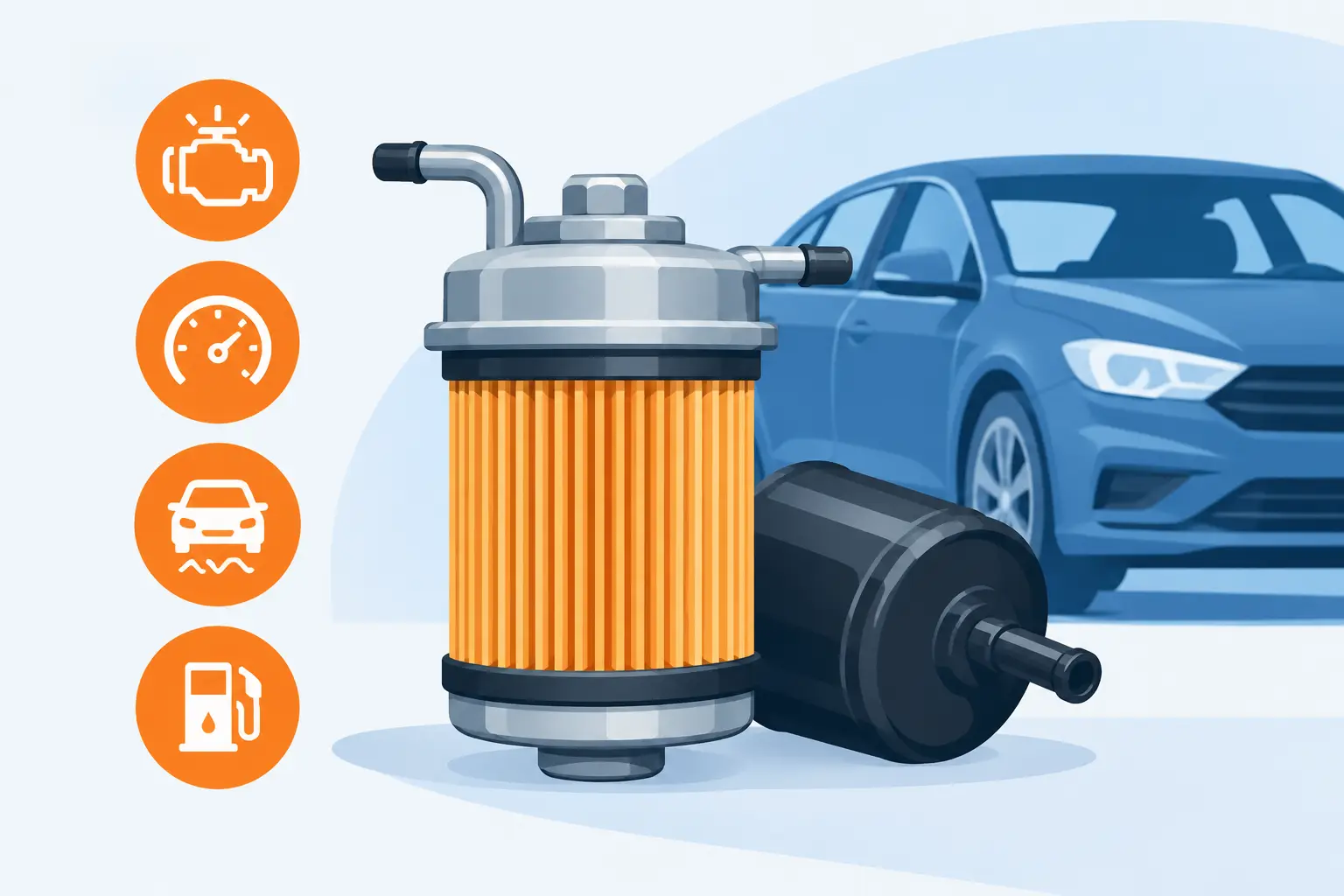
A vehicle that cruises normally but falls flat when you accelerate onto an expressway is telling you something. Among the possible causes, fuel filter replacement symptoms deserve attention because restricted fuel flow can make an otherwise healthy engine feel weak, hesitant, or unpredictable under load.
A fuel filter’s job is straightforward: stop rust, sediment, dirt, and other contaminants from reaching sensitive fuel-system components. When it becomes restricted, the fuel pump must work harder to maintain pressure, while the injectors may not receive the volume of fuel the engine demands. The result can range from a minor hesitation to a no-start condition.
What a Restricted Fuel Filter Does to Your Engine
Modern fuel-injected engines rely on accurate pressure and clean fuel delivery. At idle, a partially restricted filter may pass enough fuel for the engine to seem normal. The problem often becomes obvious during harder acceleration, hill climbs, towing, high-speed driving, or carrying a full load.
That is why a clogged fuel filter can be confused with a weak fuel pump, dirty injectors, a failing ignition coil, a mass airflow sensor issue, or even a transmission problem. Symptoms alone do not confirm the filter is at fault. A proper diagnosis matters, particularly on newer vehicles where the filter may be built into the fuel pump module inside the tank and may not have a separate scheduled replacement interval.
Fuel Filter Replacement Symptoms to Watch For
Hesitation or surging under acceleration
This is one of the most recognizable signs. You press the throttle and the engine pauses, stumbles, or surges before responding. Under demand, the engine needs more fuel. If the filter restricts flow, fuel pressure can drop at exactly the moment performance should increase.
The symptom may be intermittent at first. It can appear during a hard pass, when joining fast traffic, or when a motorcycle is climbing under load. Do not assume it is simply “bad gas” if it happens repeatedly.
Loss of power at higher speed or under load
A vehicle may idle smoothly and drive acceptably around town, then struggle at highway speed. Trucks, vans, marine engines, and equipment may show the same behavior when loaded or worked hard. This pattern points toward a supply issue because fuel demand rises as engine load rises.
A restricted air filter can also limit performance, but it affects airflow rather than fuel pressure. Both systems matter. Quality filtration protects the engine, but each filter has a different role and service requirement.
Hard starting or extended cranking
If the engine cranks longer than usual before starting, insufficient fuel pressure is one possible cause. A heavily restricted filter can contribute by reducing the fuel volume available to the injectors, especially after the vehicle has been sitting.
However, extended cranking can also come from a weak battery, worn spark plugs, a failing pump, leaking injectors, or a sensor fault. This is a good reason to test rather than replace parts at random.
Rough idle, misfires, or stalling
When fuel delivery becomes inconsistent, combustion can become inconsistent too. You may feel a rough idle, hear the engine stumble, notice misfire codes, or experience stalling when coming to a stop. In more severe cases, the engine may start and then die shortly afterward.
These issues are not exclusive to the fuel filter. Ignition and air leaks are common alternatives. Still, if rough running occurs alongside power loss and hard starts, fuel delivery should move higher on the diagnostic list.
Reduced fuel economy
A restricted filter does not always produce an immediate, dramatic drop in fuel economy. Yet an engine that struggles to meet demand can become less efficient, and drivers may compensate by applying more throttle. If fuel consumption has increased along with sluggish response, investigate the full fuel and air system.
A whining fuel pump or repeated pump failures
A fuel pump that works against excessive restriction may become louder. Some pumps make a faint hum normally, especially during priming, but a new or increasingly loud whine deserves attention. Restriction is not the only explanation, since a worn pump or wiring problem can make noise as well.
Ignoring a clogged filter can be expensive when it contributes to premature fuel-pump failure. Replacing a serviceable external filter is usually far less involved than replacing an in-tank pump module.
Why These Symptoms Happen
Fuel contamination can enter the system through aging tank components, corrosion, contaminated storage containers, poor-quality fuel handling, or debris introduced during repairs. In humid climates and equipment that sits for long periods, moisture-related contamination can be a particular concern. Diesel systems have their own risks, including water contamination and microbial growth.
Not every filter blocks gradually. A vehicle that has sat unused for months may develop symptoms soon after returning to service because old fuel deposits or tank sediment begin moving through the system. Off-road machines, marine equipment, and small engines are especially exposed when fuel storage practices are inconsistent.
The filter is designed to capture contamination before it reaches expensive components. Its restriction is therefore often a warning that the system needs attention, not merely an inconvenience to clear.
Do Not Diagnose by Symptom Alone
Before replacing a fuel filter, a qualified technician should check fuel pressure and, when appropriate, fuel volume and pressure retention. Scan-tool data, trouble codes, ignition performance, injector operation, and intake leaks may also need inspection.
This approach avoids two common mistakes. The first is replacing a filter when the real problem is a failing pump or electrical connection. The second is installing a new filter while leaving the source of contamination inside the tank, where it can restrict the new filter again.
For vehicles with a replaceable inline filter, inspect the service information for the correct interval and installation direction. Fuel systems remain pressurized after shutdown, so DIY replacement requires the right safety procedure, eye protection, ventilation, and strict control of ignition sources. If there is any fuel leak, stop immediately and correct it before driving.
For newer cars, the filter may be part of a non-serviceable in-tank assembly. In that case, replacing parts purely by mileage is rarely the right move. Follow the manufacturer’s maintenance schedule and investigate actual fuel-delivery symptoms with measured test results.
Prevention Starts With the Whole Filtration System
Use clean fuel from reputable stations, keep fuel containers clean, and avoid storing equipment with stale fuel for long periods. If your application uses a water separator, drain it at the specified interval. During any fuel-system repair, keep open lines and fittings protected from dirt.
Engine protection is a system, not a single part. Clean fuel protects pumps and injectors, while effective air and oil filtration helps reduce wear across the rest of the engine. For owners focused on long-term performance and service life, K&N Singapore supports that wider maintenance mindset with dependable filtration products designed for real driving and demanding use.
When your vehicle begins hesitating, losing power, or taking too long to start, treat the change as useful information. A timely fuel-system inspection can protect performance today and prevent a much larger repair tomorrow.